The Industry Has Accepted Digital. Now What?
Ask any construction leader today whether digital transformation matters, and the answer is almost always yes. ERP systems are being implemented. Drones are being deployed on sites. WhatsApp groups coordinate faster than any walkie-talkie ever could. Even AI has entered the conversation — with companies exploring tools for estimation, scheduling, and document management.
The intention is there and the investment is happening.
And yet, a large number of these initiatives stall, underdeliver, or quietly fade away within 12 to 18 months. The tools get blamed. The vendors get blamed. Sometimes the team gets blamed.
But in most cases, the real issue is something no one talked about before the project started: no one truly understood where the organization stood digitally before deciding where it needed to go.
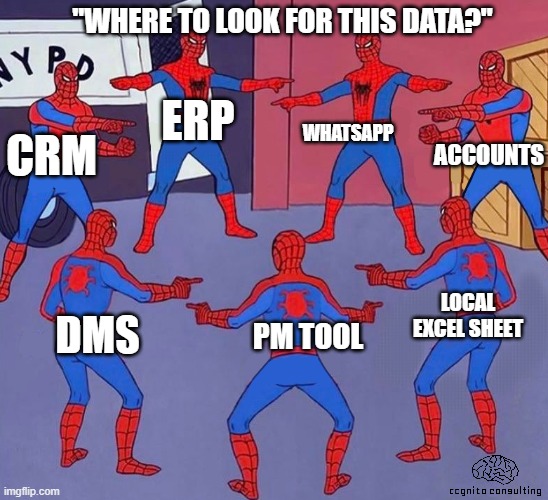
This is exactly the gap a Digital Audit is designed to close.
So Why Digital Audit, If You’re Already Going Digital?
There’s a common assumption that digital transformation is a straightforward path — identify a problem, buy a tool, train the team, done. But construction is not a factory floor with predictable, linear workflows. It’s a web of interconnected departments, subcontractors, clients, consultants, and regulatory bodies, all generating data in different formats, on different platforms, at different levels of reliability.
When you add technology into this environment without first understanding it, you’re essentially building on an unexamined foundation.
We’ve seen this happen repeatedly:
- A contractor spends ₹80 lakhs on an ERP, only to find that site teams still maintain parallel Excel sheets because the ERP doesn’t match their actual workflow.
- A developer implements a CRM but can’t get meaningful data out of it because no one defined what data should go in or why.
- A company begins an AI pilot for bid evaluation, but the underlying procurement data is so inconsistent that the model produces results no one trusts.
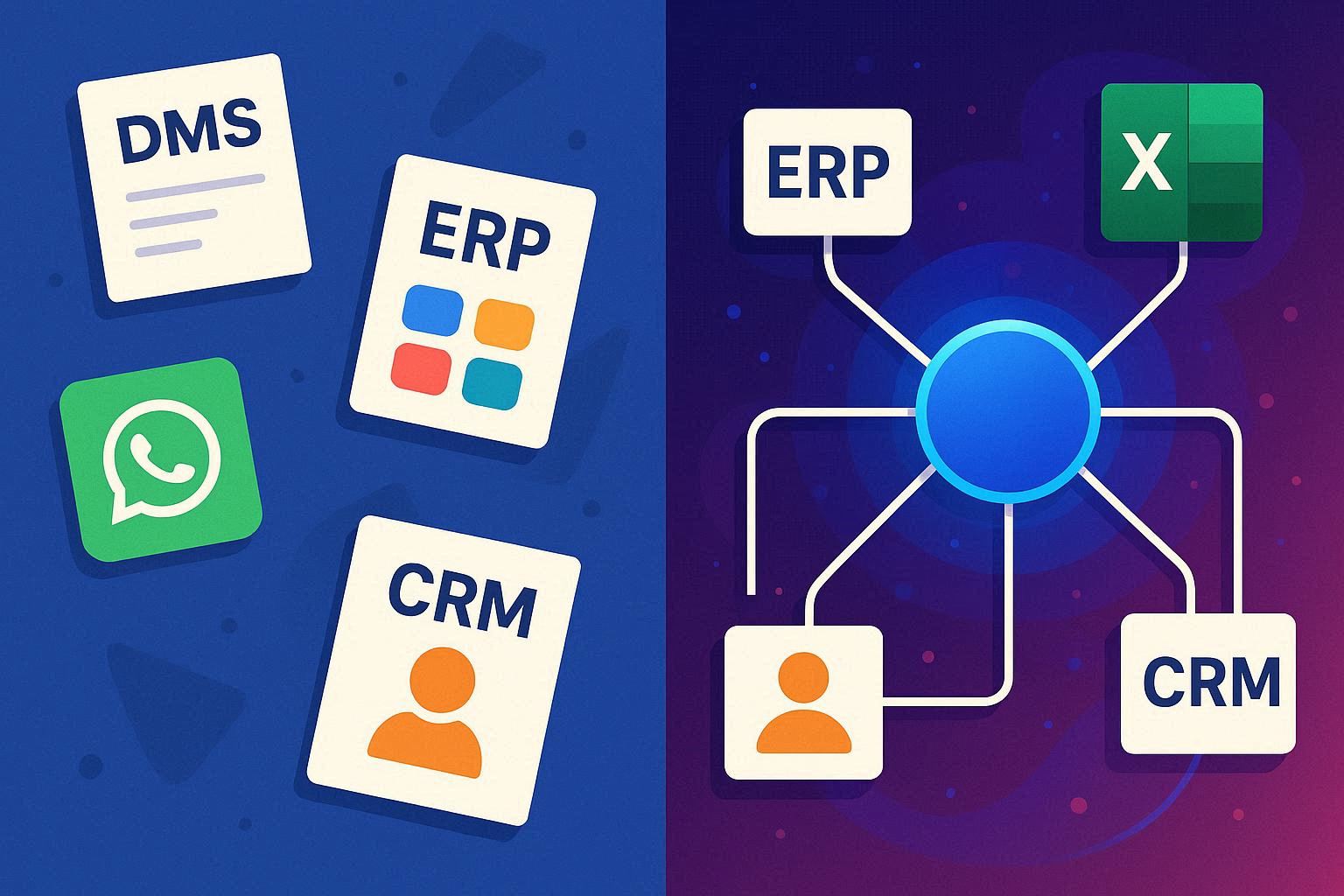
In each of these cases, a Digital Audit conducted upfront would have surfaced these gaps before money was spent — and would have pointed to a smarter starting point.
A Digital Audit is not about proving that you’re behind. It’s about understanding exactly where you are, so that every rupee and hour invested in digital transformation actually moves you forward.
What Does a Digital Audit Actually Tell You?
A well-designed Digital Audit gives you a structured, honest picture of your organization across four dimensions:
1. Process Maturity Are your core business processes — procurement, billing, planning, CRM, finance — actually documented and consistently followed? Or do they exist in the heads of a few key people and vary from project to project? Technology cannot standardize what is not yet understood.
2. Tool Landscape and Utilization What tools are currently in use? Are they actually being used as intended, or are they partially adopted? Is there duplication across departments — where three teams use three different tools to do the same job? Are you paying for licenses that sit idle?
3. Data Readiness Is data being captured systematically? Where does it live — in ERP, in spreadsheets, in PDFs, in someone’s phone? Is it structured enough to be used for reporting, let alone AI? Who owns the data, who accesses it, and is there any governance around it?
4. People and Change Readiness What is the digital literacy of the teams who will actually use the tools? Is there leadership commitment to drive adoption? What is the history of past digital initiatives — were they successful, and if not, why?
These four dimensions together give you a Digital Maturity Score — not as a report card, but as a navigation tool. It tells you where you’re strong, where the gaps are, and critically, in what sequence you should address them.
Cognito’s Approach: The Digital Audit Process
At Cognito, we’ve worked with construction and real estate companies ranging from mid-size contractors to large developers. Our Digital Audit process has been refined through these engagements into a structured, time-bound exercise that produces actionable outcomes — not a thick document that sits on a shelf.
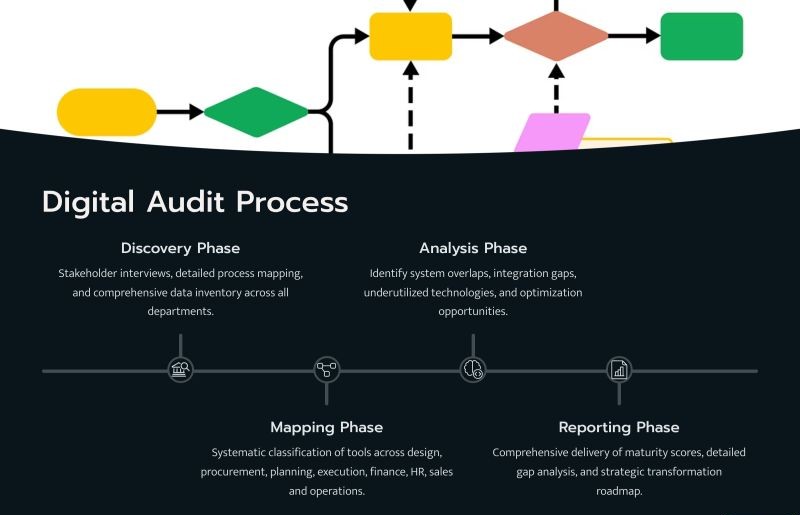
Here’s how we approach it:
Phase 1 – Discovery (Week 1) We begin by understanding your business context. What are the key functions? What’s the project portfolio? What have been the most painful operational challenges in the last 12 months? This isn’t a generic questionnaire — it’s a calibrated conversation with leadership and functional heads to understand what really matters.
Phase 2 – Tool Mapping (Weeks 2–3) We map your current processes against the tools in use — across departments like BD, Design, Procurement, Finance, Project Execution, and CRM. We identify where tools exist but aren’t used, where processes exist but aren’t digital, and where there’s no process at all. This phase often surfaces surprises even for leadership teams who believe they have a good handle on operations.
Phase 3 – Analysis (Week 3–4) We evaluate the quality, accessibility, and structure of your data. This includes looking at how data flows between departments, whether it’s captured at the source or added retrospectively, and whether it’s in a form that can support analytics or AI applications in the future.
Phase 4 – Reporting Using our Digital Maturity Framework, we score each function and process area across four dimensions. We also benchmark your scores against industry peers — construction companies at similar scale and stage — so you know not just where you are in absolute terms, but relative to what’s achievable.
Outcome – Findings, Roadmap, and Prioritization The audit culminates in a clear, prioritized roadmap. Not a list of 50 things to fix, but a sequenced plan: what to address in the next 90 days, what to plan for in the next year, and what the 3-year digital vision looks like. Each recommendation is tied to a business outcome — not just a technology feature.
The entire process typically takes 4 to 6 weeks, depending on organizational size, and involves minimal disruption to ongoing operations.
The Hidden Value: What the Audit Reveals Beyond the Obvious
Beyond the expected findings, Digital Audits consistently surface a few things that organizations did not anticipate:
The “Ghost Tool” Problem Most organizations are paying for tools they barely use. Licenses, subscriptions, and maintenance contracts for software that’s underutilized or completely abandoned. A Digital Audit helps rationalize this spend immediately — often recovering a budget that can be redirected to better-fit solutions.
The Data Bottleneck You Didn’t Know Existed Almost every organization has one department or one person who is the unofficial custodian of critical data. When that person leaves, or is unavailable, decisions stall. The audit identifies these single points of failure and recommends structural fixes.
The Process That Needs Fixing Before the Tool A recurring finding is that some processes are simply not ready for digitization. If the procurement approval process has 6 informal steps and 3 people who each interpret it differently, no software will fix that — until the process itself is defined. The audit helps separate “needs a tool” from “needs a process fix first.”
The Quiet Champions In most organizations, there are 2 or 3 people who have already built workarounds — smart Excel macros, Power BI dashboards, or even custom WhatsApp bots — to solve real problems. A Digital Audit finds these individuals and their solutions, which often become the foundation for organization-wide adoption.
From Digital Audit to AI-Ready: The Bigger Picture
Here’s something we’ve observed consistently: organizations that jump straight to AI without a digital foundation do not get the results they expect. Not because AI doesn’t work, but because AI depends entirely on the quality, structure, and reliability of data — and most construction companies haven’t built that foundation yet.
The Digital Audit is, in a very real sense, Step Zero on the path to an AI-ready organization.
Here’s what that journey looks like:
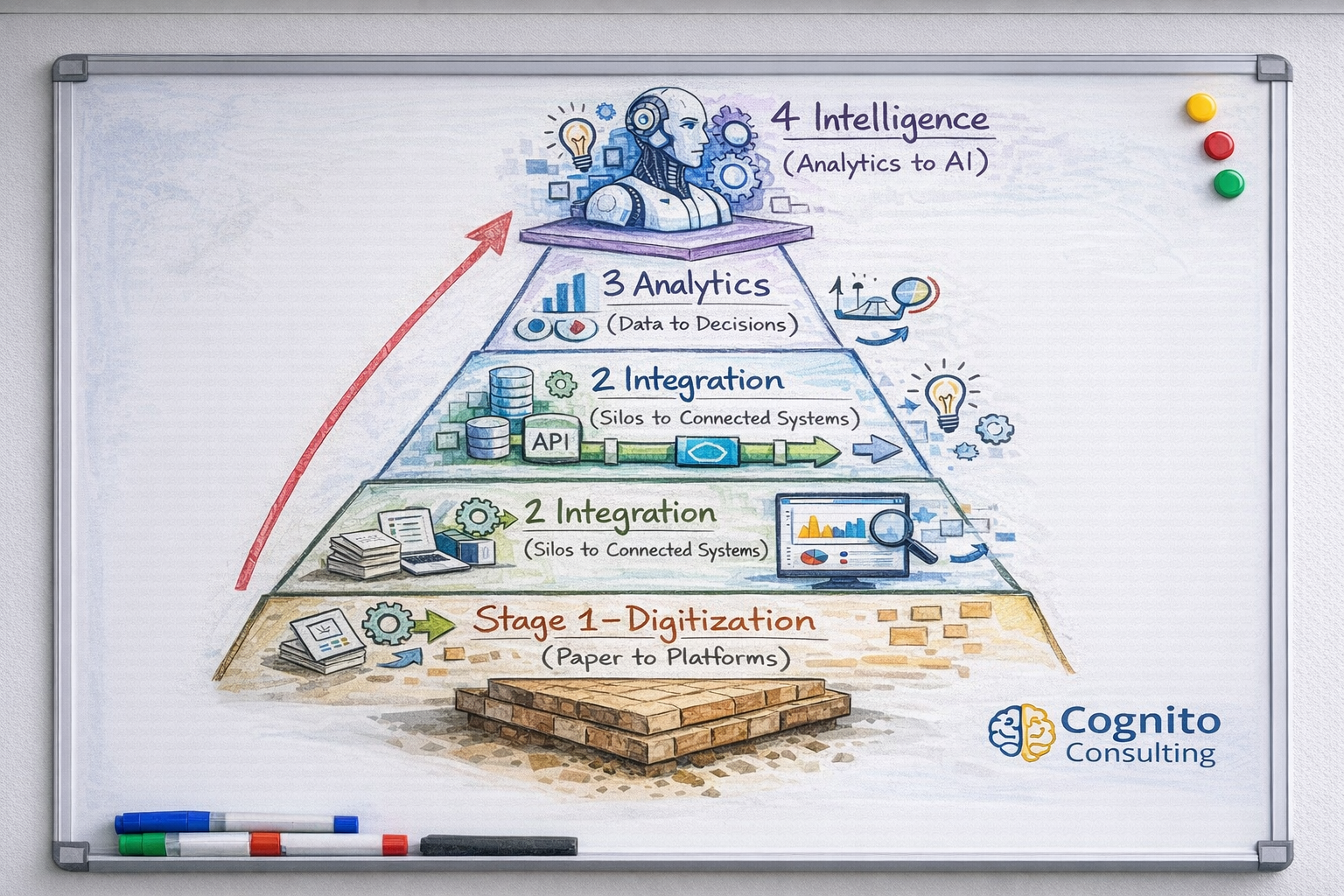
Stage 1 – Digitization (From Paper to Platforms) Getting core processes onto digital tools. ERP for procurement and finance. Project management software for scheduling. Field apps for site data collection. This is the foundation layer.
Stage 2 – Integration (From Silos to Connected Systems) Connecting disparate tools so data can flow between them. Building the pipes so that progress data from site can speak to billing data in finance. This is where data lakes and APIs become relevant.
Stage 3 – Analytics (From Data to Decisions) Using connected data to generate dashboards, reports, and KPIs that leadership can actually act on. Moving from “looking at the past” to “understanding the present in real time.”
Stage 4 – Intelligence (From Analytics to AI) Once data is clean, connected, and consistently captured, AI becomes viable. Predictive delay alerts, AI-powered bid evaluation, automated document review, intelligent procurement forecasting — all of these become possible and, more importantly, trustworthy.
A Digital Audit tells you exactly which stage each part of your business is at — and gives you a realistic pathway to move up. It prevents the mistake of trying to build Stage 4 capabilities on a Stage 1 infrastructure.
For organizations actively pursuing AI adoption, the audit also includes an AI Readiness Assessment — evaluating not just data maturity but also governance readiness, team capability, and risk management posture. This is particularly relevant given India’s evolving Digital Personal Data Protection (DPDP) Act, which has direct implications for how construction and real estate companies collect, store, and process project and client data.
What You Walk Away With
A Cognito Digital Audit is not a theoretical exercise. At the end of the engagement, you receive:
- A Digital Maturity Score across all key business functions, mapped to industry benchmarks
- A Process-Tool Map showing current state: what’s manual, what’s digital, what’s missing, what’s redundant
- A Data Readiness Assessment identifying gaps that would block analytics or AI initiatives
- A Prioritized Digital Roadmap with 90-day, 1-year, and 3-year horizons — tied to business outcomes
- An AI Readiness Snapshot showing what’s needed before any AI investment makes sense
- Vendor-neutral recommendations — we don’t sell software, so our recommendations are based purely on what fits your context, not what earns us a commission
Is This Right for Your Organization?
A Digital Audit is most valuable for companies that:
- Have started or are planning digital transformation but are unsure where to begin or why previous attempts underdelivered
- Are evaluating a significant technology investment (ERP upgrade, AI pilot, data platform) and want to ensure the foundation is right
- Have grown significantly in the last 3 to 5 years and suspect their digital setup hasn’t kept pace with their operational complexity
- Are in the early stages of an AI strategy and want a clear-eyed view of their readiness
If any of these describe your organization, the conversation is worth having.
Final Word: Clarity Before Investment
Construction companies today face a peculiar challenge. The pressure to “go digital” and “adopt AI” is real — from clients, from competitors, and from within leadership teams. But acting on that pressure without first understanding where you stand is how you end up with expensive tools that no one uses and digital initiatives that become cautionary tales.
A Digital Audit gives you something more valuable than a tool recommendation. It gives you clarity — on where you are, where the gaps are, and what sequence of steps will actually get you to where you want to be.
In construction, we don’t start a project without a soil test. We don’t begin a structure without understanding what the ground can hold.
A Digital Audit is your soil test for technology. Do it before you build.
If you’d like to explore a Digital Audit for your organization, let’s start with a free 30-minute conversation.
This article was co-developed by the Cognito Consulting team in collaboration with Claude, Anthropic’s AI assistant, to bring clarity to a subject that is often overcomplicated. Written by Chaitanya Bharech, Founder, Cognito Consulting.